


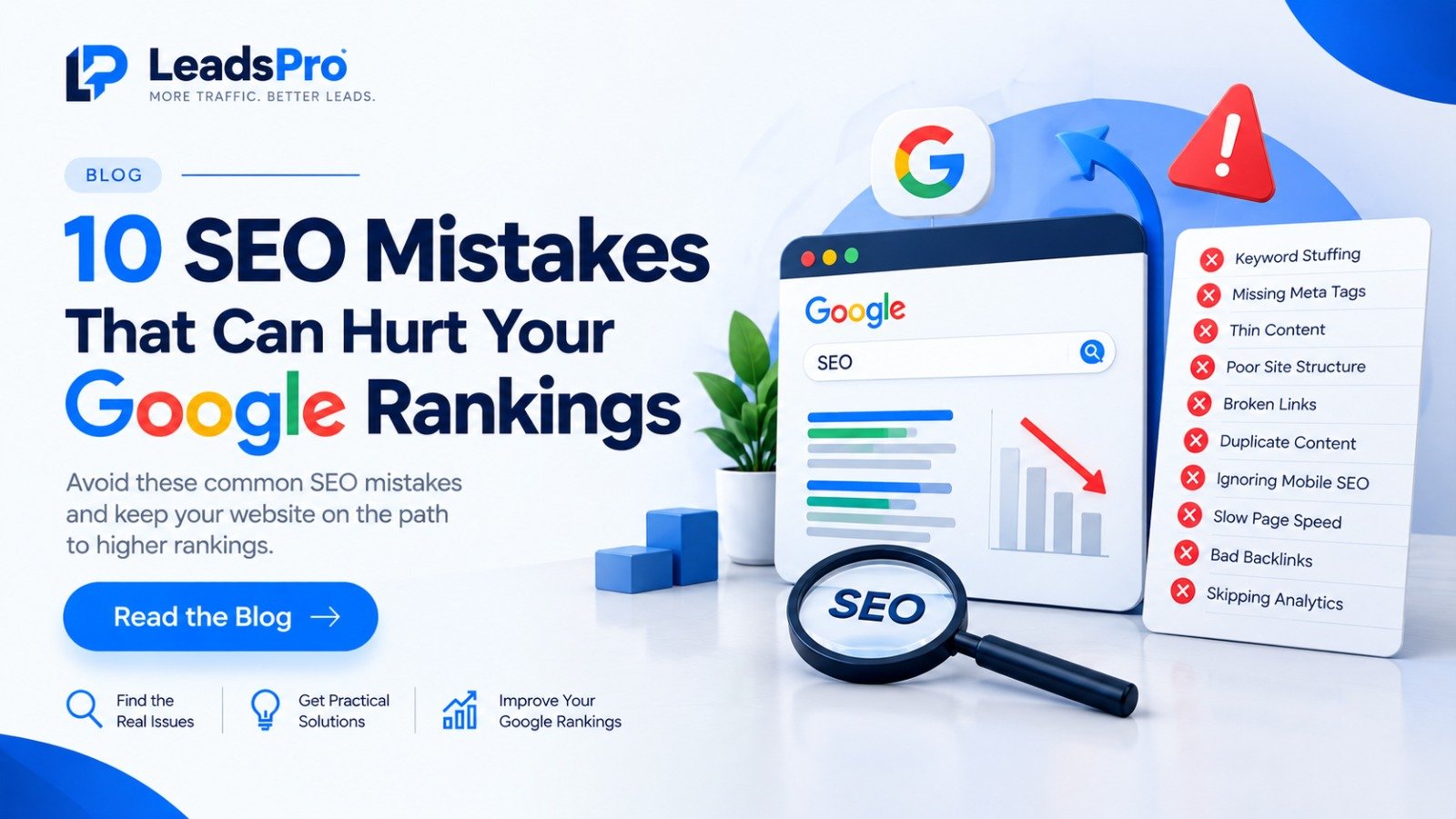
10 SEO Mistakes That Can Hurt Your Google Rankings
Getting a website online is easy.
Getting the right people to find it is a different challenge.
SEO has changed a lot over the years, but many businesses still make the same basic
mistakes. Some focus too heavily on keywords, others publish content without a real
strategy, and some don’t pay attention to the technical side of their website at all.
If your website isn’t performing as well as you’d like in Google Search, here are 10 areas
worth checking.
1. You’re Targeting the Wrong Keywords
A keyword isn’t valuable simply because a lot of people search for it.
It needs to be relevant to your business.
For example, a local plumber might get more value from ranking for:
“emergency plumber near me”
than from ranking for a huge general term that has little buying intent.
Think about what your actual customers would search before contacting you.
2. You’re Ignoring Search Intent
Two searches can contain similar words but have completely different intentions.
Someone searching:
“what is PPC advertising?”
probably wants information.
Someone searching:
“PPC agency near me”
may be looking for a service provider.
Your content should match what the searcher is actually trying to accomplish.
3. You’re Publishing Content Just to Have More Content
More blog posts don’t automatically mean better SEO.
If you’re publishing 20 articles that say almost the same thing, you’re not necessarily helping
your website.
Before writing an article, ask:
Does this answer a question my customers actually have?
Does it provide something useful?
Would I recommend this article to someone?
Google’s guidance focuses on helpful, reliable, people-first content rather than content
created primarily to manipulate search rankings.
4. Your Page Titles Are Too Generic
Page titles tell users and search engines what a page is about.
A title like:
“Services”
doesn’t tell anyone much.
Something like:
“SEO Services for Small Businesses | Leads Pro”
is much more descriptive.
Google also recommends creating descriptive, concise titles that accurately represent the
page.
5. Your Website Is Difficult to Use on Mobile
Open your website on your phone.
Don’t just look at it.
Actually use it.
Try navigating the menu, reading an article, clicking your buttons, and submitting your
contact form.
If anything feels frustrating, your customers may be experiencing the same thing.
6. Your Pages Are Slow
People don’t enjoy waiting for a website to load.
Large images, unnecessary scripts, poor hosting, and inefficient code can all contribute to
slow pages.
Check your website regularly and look for areas that can be improved.
Speed isn’t just a technical issue. It’s part of the experience you’re giving your visitors.
7. You’re Not Using Internal Links
Imagine someone reading your blog about SEO.
They finish the article and leave.
Now imagine the article naturally links to your SEO Services page, another useful SEO
article, and a related guide.
The visitor has somewhere useful to go next.
Internal linking helps visitors discover relevant content and gives search engines additional
context about the pages on your site.
8. You’re Ignoring Local SEO
If your business serves a particular area, local search can be extremely important.
Think about the searches your customers make when they’re ready to hire someone.
“Marketing agency in [city]”
“Roof repair near me”
“HVAC contractor near me”
Make sure your business information is accurate and consistent and that your website
clearly communicates your service areas where relevant.
9. You Don’t Have a Real Content Strategy
Publishing random topics every week isn’t a strategy.
Your content should support your business.
If you sell SEO services, your blog should cover the questions, problems, and decisions that
potential SEO customers are dealing with.
That could include:
● SEO costs
● SEO mistakes
● Local SEO
● Technical SEO
● Keyword research
● Google rankings
● SEO vs PPC
This creates a website that’s useful to both your audience and your business.
10. You Expect Results Too Quickly
SEO takes time.
The timeline can vary significantly depending on the website, competition, industry, content,
authority, and amount of work being done.
Instead of constantly looking for a shortcut, focus on making your website better.
Create useful content.
Fix technical problems.
Improve the user experience.
Build relevant authority.
And keep measuring what happens.
SEO Is More Than Just Keywords
Keywords matter, but they’re only one part of the picture.
A strong SEO strategy brings together:
Useful Content + Technical SEO + Search Intent + User Experience + Relevant
Authority
When these pieces work together, your website has a much stronger foundation for organic
search visibility.
At Leads Pro, we help businesses identify SEO problems, improve their websites, and build
strategies designed to attract relevant traffic and generate business opportunities.
Think Your Website Has SEO Problems?
Talk to Leads Pro today about improving your website’s search visibility.
Frequently Asked Questions
What are the most common SEO mistakes?
Some common mistakes include targeting irrelevant keywords, ignoring search intent,
publishing low-value content, having poor page titles, slow websites, weak internal linking,
and neglecting local SEO.
Can SEO mistakes hurt my Google rankings?
SEO problems can make it harder for search engines to understand your website and can
also create a poor experience for visitors.
How can I improve my website SEO?
Start by reviewing your technical SEO, content, keyword targeting, search intent, internal
links, mobile experience, and page performance
Recent Posts

September 10, 2026
Why Your Website Isn’t Generating Leads

September 10, 2026




Leave a comment